

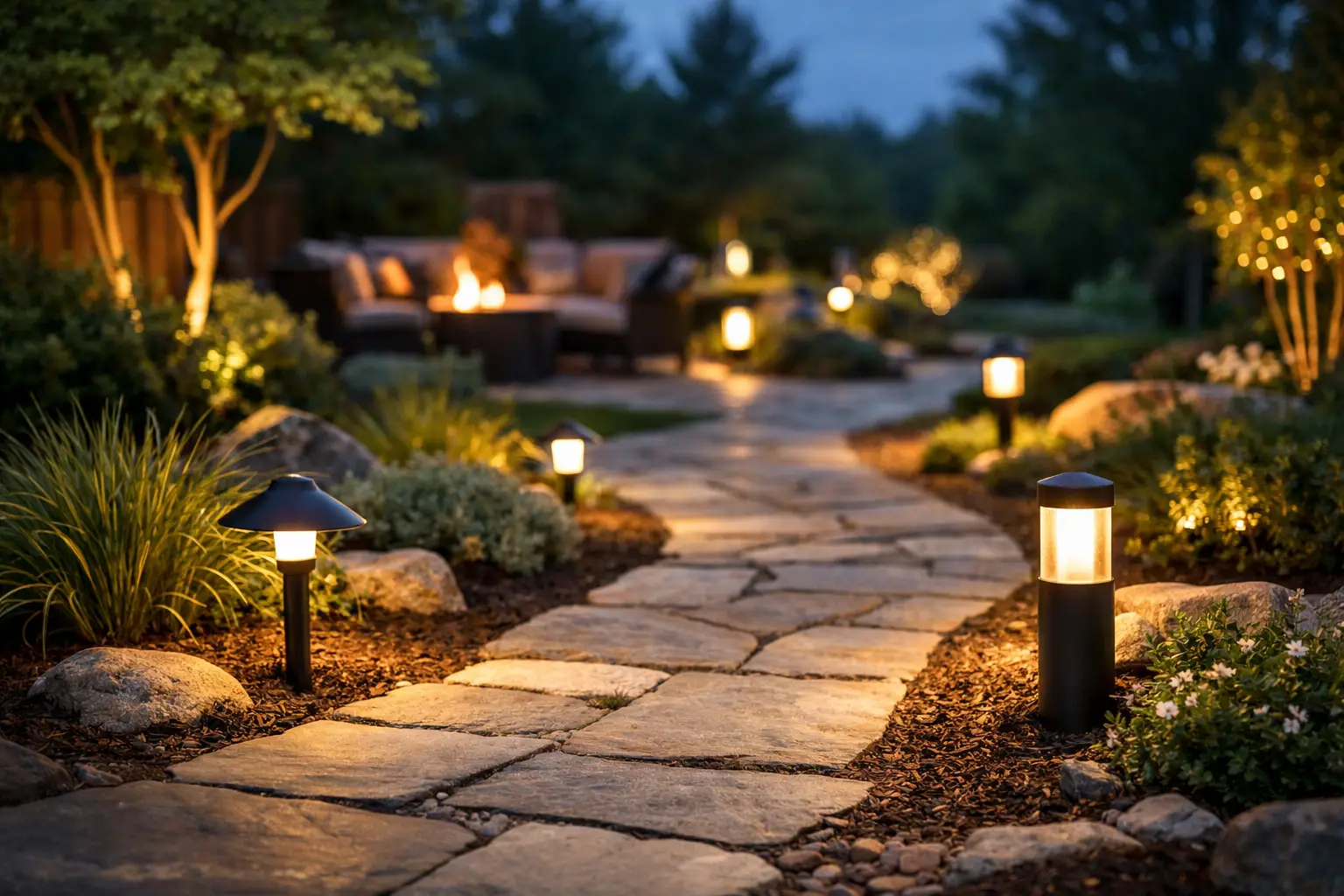
A walkway should not disappear when the sun goes down. It is the quiet thread that carries family and guests from the patio to the pool, past a pond, or toward a fire pit at the end of a long evening. Knowing how to light a backyard walkway is about more than seeing where to step. Done well, lighting makes the entire backyard feel warmer, safer, and more like the retreat you intended it to be.
The goal is not to flood the path with bright light. A beautiful landscape feels inviting because it has contrast: softly lit walking surfaces, darker planted areas, and a few thoughtful highlights that reveal stone, water, and architectural details. The result is a backyard that calls you outside after sunset instead of closing down for the night.
Start with the experience of the walk
Before choosing fixtures, walk the route at dusk. Notice where the path begins, where it turns, where grade changes occur, and where someone might pause to look at the water or join a conversation. A straight flagstone path to an outdoor kitchen needs a different approach than a winding garden walk that leads to a tucked-away seating area.
Think about what the path connects. If it runs between the home and a pool or spa, safety is the first priority. If it leads past a waterfall or koi pond, the lighting should also make room for the view. A fixture placed without considering sightlines can create glare on the water or turn a peaceful focal point into a collection of visible hardware.
At Uni-Scape, walkway lighting is most successful when it is considered as part of the whole outdoor environment: patios, plants, rock work, water features, gathering areas, and the way your family actually moves through the space.
Choose a warm, low-glare light
For most residential backyards, warm white light creates the most comfortable atmosphere. Look for LEDs in the 2700K to 3000K range. These tones resemble the gentle warmth of an incandescent bulb, complementing natural stone, wood, lush planting, and the soft movement of water.
Cool blue-white lighting can make a path visible, but it often feels harsh against a relaxing backyard setting. It may also flatten the rich textures that make flagstone, boulders, and foliage feel special after dark.
Brightness matters just as much as color. A walkway does not need stadium-level illumination. In many cases, low-lumen fixtures provide enough guidance while preserving the calm, layered mood of the landscape. The exact output depends on the fixture, surrounding ambient light, and the path material, but when in doubt, favor softer light with better placement over a few overly bright fixtures.
Keep the source of light out of direct view
Glare is one of the quickest ways to make beautiful lighting feel uncomfortable. If someone can see a bare bulb from across the patio, the fixture is likely too exposed, too bright, or aimed poorly.
Choose path lights with shields, hoods, or downward-facing designs that direct light onto the walking surface. For steps, recessed or shielded step lights can define each change in elevation without shining into a guest’s eyes. The light should feel present, but the fixture itself should stay visually quiet.
Use the right fixture for each part of the path
A single style of path light can work for a simple walkway, but high-end outdoor spaces often benefit from a mix of lighting techniques. The key is restraint. Use each fixture where it solves a real visual or functional need.
Traditional path lights are effective along open garden walks and the edges of flagstone routes. Their downward wash of light helps define the path while keeping surrounding planting softly visible. They work especially well when spaced thoughtfully rather than installed in a perfectly rigid line.
Hardscape lights fit naturally into stone walls, seat walls, raised planters, and the underside of countertop overhangs. They are an elegant option around patios and outdoor kitchens because they illuminate edges without cluttering the space with posts or stakes.
Step lights deserve special attention wherever a walkway rises or drops, even by a few inches. A low stone step can be easy to miss at night, particularly when guests are carrying drinks or children are moving between the pool and patio. A small amount of directed light here delivers an outsized safety benefit.
Downlighting from a tree, pergola, or nearby structure can also be useful when a path passes through a planted area. This creates a natural, moonlit effect and avoids lining every inch of the walk with fixtures. It depends on the site, though. Mature trees, mounting locations, and future pruning needs all affect whether downlighting is practical.
Place fixtures for guidance, not runway lighting
The most common mistake in backyard walkway lighting is placing fixtures too close together and too symmetrically. The path can begin to resemble a runway, with harsh pools of light and dark gaps between them.
Instead, position lights to help people read the route. Place them near turns, intersections, changes in surface material, gates, steps, and transitions from one outdoor room to another. On a curving path, staggering fixtures along the outside of the curve can reveal its shape naturally. On a narrow path, alternating sides often looks more relaxed than installing matching pairs directly across from one another.
Spacing varies with the fixture’s output and beam spread, so there is no universal measurement that works in every backyard. As a starting point, many low-voltage path lights are placed roughly 8 to 12 feet apart, then adjusted based on the actual effect after dark. Wider pools of light can be spaced farther apart. Small, focused fixtures may need to be closer.
Do not forget the beginning and end of the journey. A welcoming light at the patio entry, pool gate, or garden destination gives the walkway a sense of purpose. It also helps guests orient themselves when they look back toward the house.
Layer walkway lighting with the landscape
A well-lit path becomes more beautiful when the spaces around it are gently revealed. This is where landscape lighting changes from a safety feature into part of the atmosphere.
Use a soft uplight to bring out the canopy of a palm, the trunk of a mature tree, or the form of a specimen plant near the walkway. Add subtle illumination to a stone wall or boulder grouping so the path does not feel like it is floating in darkness. Near a waterfall or pond, carefully aimed lighting can catch moving water and give the route a tranquil focal point.
The balance matters. If every tree, shrub, and feature is lit, the backyard loses depth and becomes visually busy. Leave portions of the garden in shadow. Darkness is not a problem to eliminate – it is what makes the lit areas feel restful, dimensional, and intentional.
Protect the night around pools and water features
In Southwest Florida, water often becomes the heart of the backyard. A pool, spa, fountain, or pond adds sound, reflection, and a natural place for people to gather. Walkway lighting around these features must be designed with both beauty and safety in mind.
Avoid aiming fixtures directly across water toward seating areas or the home, where reflection can create glare. Make sure routes around wet areas and equipment access points are clearly visible. Electrical work around pools, spas, and water features should always be planned and installed according to applicable codes by qualified professionals.
Plan for durability and simple control
Low-voltage LED landscape lighting is a strong choice for most backyard walkways. It is energy-efficient, flexible to expand as the landscape evolves, and available in fixtures suited to humid, rainy Florida conditions. Quality materials make a real difference outdoors. Brass, copper, and professional-grade finishes generally weather more gracefully than lightweight fixtures that can fade, crack, or corrode.
Use a properly sized transformer, durable cable, weather-rated connections, and a lighting plan that accounts for voltage drop on longer runs. These details are easy to overlook, but they affect brightness, reliability, and how much maintenance the system requires over time.
Controls should fit your routine. A timer or photocell ensures the path is lit when evening arrives. Smart controls can add convenience when you are entertaining, traveling, or adjusting seasonal schedules. Keep the system simple enough that it supports the way you live rather than becoming another thing to manage.
Test the design after sunset
Even an excellent daytime plan needs a nighttime check. Turn the system on, walk the path from both directions, sit in nearby seating areas, and look toward the house. Are turns and steps easy to see? Does any fixture shine into your eyes? Is the path bright enough without overpowering the patio, pond, or garden?
Small adjustments can transform the result. Moving a fixture a few feet, changing an optic, adding a shield, or lowering the output may create a far more natural effect. Plants also grow, stone patios get rearranged, and outdoor living spaces evolve, so revisit the lighting as the backyard changes.
The best walkway lighting does not demand attention. It lets a child safely find the patio, guides friends toward the fire, and makes a quiet walk past the garden feel like part of the evening’s reward. When the path is softly visible and the destination feels even more inviting, your backyard has become a sanctuary that lasts well beyond daylight.